


As the world’s oil and gas basins mature, work is under way to permanently plug and abandon wells safely and cleanly, including in the North Sea.
Two key elements are driving the global wave of oil and gas plug and abandonment (P&A) projects: the fact that many fields and basins are at or near the end of their recoverable reserves and the progression of the energy transition.
“It’s getting harder and harder to extract the remaining resources from mature basins,” says Ashish Goel, who has been with Baker Hughes for more than 20 years. He is now Vice President of drilling services and former managing director of the North Sea Geozone. “Our Mature Assets Solutions program is bringing new technologies and methods to help with that. Operators carry a huge liability on their books with wells that are close to retirement. They need to be able to permanently, safely and in an environmentally friendly way plug and abandon wells that are no longer economically viable.”
In the North Sea, home to some of the world’s most mature basins, offshore P&A programs are an enormous undertaking for operators, who must decommission platforms, rigs and subsea structures as well as permanently plug the wells. Geopolitical issues have meant that mature basins have continued to be an important part of global production, but that is also winding up.
“The time has come and in essence, the P&A wave is starting in the North Sea,” says Goel.
Baker Hughes launched its Mature Assets Solutions program in 2024 to help customers maximize the operational efficiency of older fields and to bring the technologies and expertise to safely retire them permanently.
Streamlining P&A with integrated services
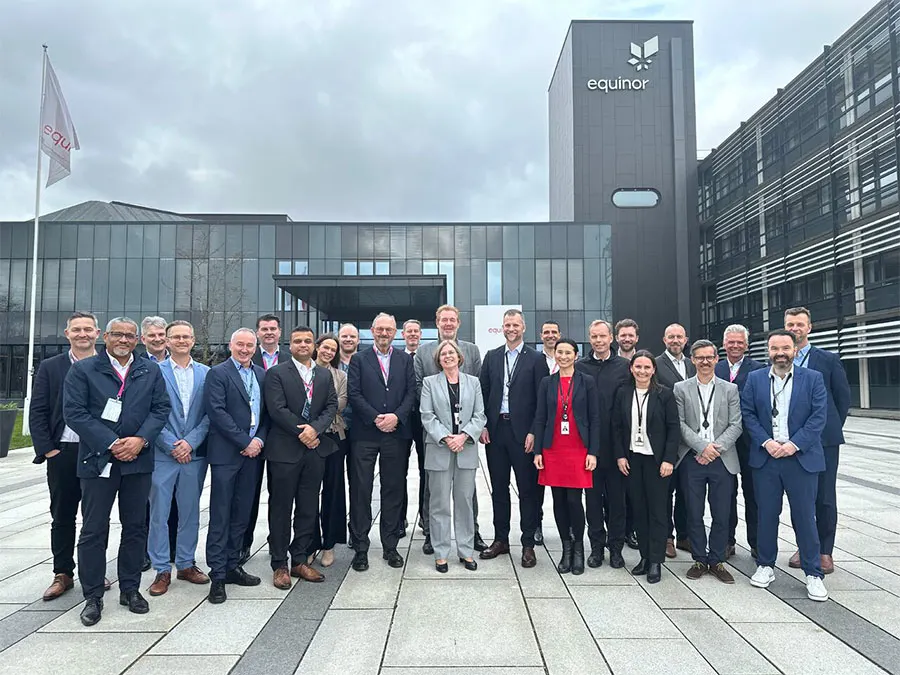
Of course, offshore P&A is a vastly more complex process than onshore. That’s one of the reasons that in March 2025 Norway’s majority state-owned energy company Equinor awarded Baker Hughes a multi-year framework agreement. The energy technology company will provide integrated P&A services in the North Sea, where the anticipated P&A boom is already beginning.
“Equinor has been looking at their entire portfolio, which has a significant number of mature assets on the Norwegian continental shelf,” says Tom Huuse, managing director, Baker Hughes Norway and enterprise growth leader for Northern Europe.
“Equinor is of course also very focused on energy security, and they need to keep today’s production levels until 2035,” explains Huuse. “To do that, they need to drill new production wells and doing that in parallel with such a big P&A program is of course challenging, hence they are looking for more vendor-led solutions in the P&A space.’’
This led to Equinor’s decision to engage Baker Hughes to help them industrialize P&A operations to drive efficiencies. End-to-end integration will see Baker Hughes work closely with Equinor to identify the most efficient P&A path for each asset. Baker Hughes will do the planning in consultation with Equinor before moving into the physical P&A execution.
It’s a new approach.
“Before this framework agreement, Equinor would do the planning and subsurface studies before engaging us as a service provider for our particular expertise and solutions,” says Huuse.
Engaging the Baker Hughes Mature Assets Solutions team to provide project management services on behalf of Equinor aims to unlock a new level of efficiency.
“By being involved from the beginning, we will be working with Equinor and also the rig and platform drilling providers to set up a one team approach for P&A,” says Knut Inge Dahlberg, European & Caspian sales director for mature assets and integrated solutions.
This collaboration frees up the Equinor team’s time while ensuring they have complete visibility of the P&A planning.
“Equinor is the operator and will review and sign off on the programs and cost estimates, so they will be part of our team,” explains Dahlberg. “Once we move to execution, as usual the operator is less involved, and we work with the rig or platform drilling companies. The advantage is we have been able to offer our advice on the best well abandonment solutions from the beginning, rather than when the plan has already been made.”
“Being involved in the P&A planning from the start means we can figure out where technology best fits and it will also inform our tech R&D,” adds Goel.


Unlocking financial positives
Because P&A marks the end of production, there’s a natural tendency for operators to see it as an expense. However, the big picture is more nuanced.
“When operators drill a well in the North Sea, regulations dictate that they must hold a certain value – an Asset Retirement Obligation (ARO) - a liability recorded on the balance sheet on their books for the liabilities of P&A later,” says Goel. “Over time, the liability increases through accretion expense (a non-cash operating expense) and is settled with cash only when the asset is retired- once they actually complete the P&A for that well.”
It’s estimated that there are over $200 billion dollars in P&A liabilities currently locked into various operators’ books.
“Any efficiency gain during the P&A program directly links to a positive impact on their balance sheet once they complete the P&A and unlock those liabilities,” says Goel. They have been holding a prescribed amount on their books for each well’s future P&A program. If it can be completed safely and securely and according to all regulations for less than that amount, it’s an instant win for the bottom line.
“Operators are understandably very keen to find efficiencies in their P&A efforts,” says Goel.
The Baker Hughes mature assets team is confident of doing just that.
“As a solution provider with this massive toolbox, we know that at the planning stage we are proposing the right tool for the right mission. This ensures the totality of the planning makes sense,” says Huuse. “Equinor is trusting us to step outside of their normal way of doing things. This is because we’ve been able to demonstrate our deep expertise and range of solutions”
While results today have been impressive, the Baker Hughes team continues to look for new approaches and innovations for improvement.
“While we are now doing most of the planning and finding the right solutions for each asset, we don’t say we have all the solutions for execution,” says Dahlberg. “We will make sure that we propose the right solutions for the right applications to make the cost of P&A as low as possible. It’s important to drive P&A in a new way, understanding that while one company will not have everything required, we will bring it all together as one team.”
One Team and a new Center of Excellence
The drive to unlock greater efficiencies for P&A projects – beginning with Equinor’s extensive program – will be anchored by a new P&A Center of Excellence in Stavanger, Norway. The hub, established in late 2024, brings together P&A project managers and experts to centralize the team for the North Sea programs.
“This hub brings together industry veterans who carry deep technical expertise on P&A operations” says Goel. “It’s a Center of Excellence where multiple domains are coming together to work towards an incremental improvement cycle. The learnings will come from the North Sea’s mature basins. The U.S. Gulf Coast has a lot more P&A activity than in the North Sea, and this will increase, the same thing with offshore Brazil and Africa.’’
Improved remote operations and continuous technology development are key. “We are finding ways to drive efficiencies and continuously improve well by well, project by project, to further drive down time and costs,” says Goel. “We already have interest from other operators who are also keen to get us involved early in a similar fashion for this integrated approach.”
Improving remote operations has long been a key focus for offshore production and bringing it to P&A programs is a new frontier.
“We are accelerating that learning of well construction and taking it into P&A,” says Goel. “We are creating new roles and responsibilities. We now have more remote roles with P&A expertise to start taking people from offshore and putting them in the onshore operations center. We already have a fully-fledged remote operations center today here in Stavanger for well construction activity, and now we are starting on integrated P&A remote operations.”
Having one team focused on P&A specialization is an important distinction.
“Normally when you plan for P&A, you’d have a well engineer who’s done construction and completion,” says Dahlberg. “We have set up ‘one team’ who are already specialists at P&A. They will gather data for pre-P&A, do the planning and integration with the operator and other service providers, to assemble the solutions. This ‘one team’ is gathering experience on other projects, learning all the time.”
Time to shine
The P&A boom will also put to work a range of Baker Hughes specialist technologies from its well abandonment portfolio.
“Step one is when we develop a technology, but then we need operators to test it so we can refine it and accelerate its deployment,” says Goel. “One technology which will be very important is our CICM Casing Integrity and Cement Mapping. These services have already enabled significant efficiencies on various rigs. This is an example of an existing technology that was waiting to be deployed in a repeated manner for qualifications. Now we have already qualified it with at least two operators, and we are working faster to deploy it”
“From our platform to LinkedIn’s energy professionals – your announcements reach the entire sector’s network, not just our readers.”