


By Tsvetana Paraskova
Oil and gas operators offshore Norway continue to make discoveries on the shelf and extend the lifetime of producing fields, while the Norwegian government continues to highlight the importance of Norway’s energy production for Europe’s security of supply.
Field Development and Digital Alliances
Vår Energi in early December confirmed an oil discovery in the Goliat North exploration well, located close to the Vår Energi operated Goliat field in the Barents Sea.
The exploration well located five kilometres north of the Goliat field encountered hydrocarbons in the Realgrunnen and Kobbe formations. Estimated gross recoverable resources encountered are up to 5 million barrels of oil equivalent (mmboe).
The Goliat North well is an integral part of the Goliat Ridge appraisal drilling programme. Vår Energi and partner Equinor plan to drill a total of four wells in the Goliat Ridge, with the Zagato side track currently ongoing. Following completion of the appraisal programme Vår Energi will assess the entire potential of Goliat Ridge utilising the extensive data acquisition combined with the newly acquired 3D seismic data.
Including the Goliat North discovery, the Goliat Ridge is estimated to contain gross discovered resources of 39 to 108 mmboe and with additional prospective resources taking the total gross potential to up to 200 mmboe. The operator plans a tie-back of the Goliat Ridge discoveries to the nearby Goliat FPSO.
Equinor launched on 2 December production from the Verdande subsea field in the Norwegian Sea via a tie-back to the Norne FPSO. With reserves of 36 million barrels of oil, Verdande will help extend Norne’s production beyond 2030, the Norwegian energy major said.
The field has been developed with three wells in a template tied back to the Norne field via a pipeline.
“Fast and cost-efficient field developments like this – where smaller discoveries are realised through smart use of existing infrastructure – are key to further developing the Norwegian continental shelf,” said Trond Bokn, senior vice president for project development at Equinor.
“The Norwegian continental shelf is changing, and many of the fields being developed are smaller subsea fields tied back to existing infrastructure,” Equinor noted.
“This approach reduces both costs and environmental footprint.”
Equinor has now tied six subsea fields back to the Norne FPSO, including Andvare, which started up in September, and now Verdande, said Grete Haaland, senior vice president for Exploration and Production North at Equinor.
“By developing smaller discoveries around established fields, we maximise resource recovery and extend the lifetime of existing infrastructure. This is good resource management and good socioeconomics,” Haaland added.
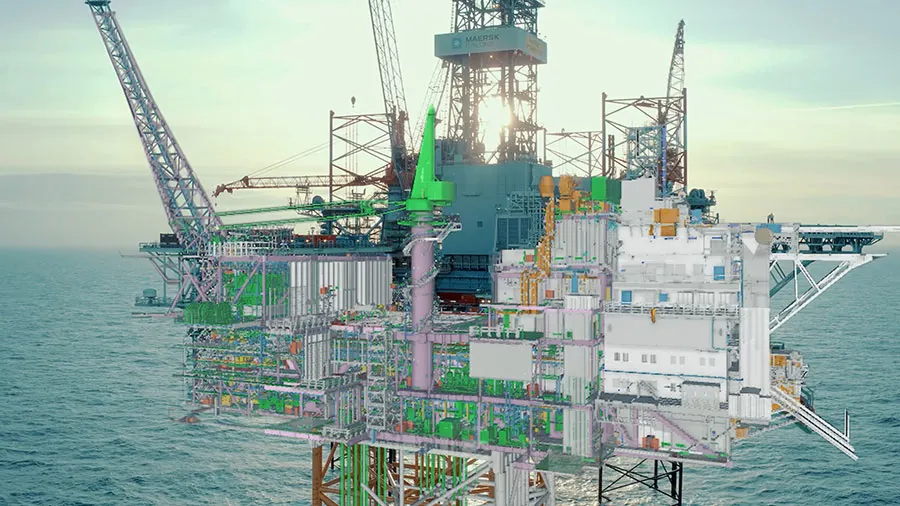
Aker BP is celebrating ten years of production at the Edvard Grieg field and has introduced a new area name-Eiga.
Edvard Grieg, which began production on the Utsira High in the North Sea ten years ago, has been a pioneer on the Norwegian continental shelf, with a platform built in Norway and a vision to serve as a hub for future developments.
Since 2022, Edvard Grieg has been part of the combined Grieg Aasen asset. The fields are now taking a new step into the future with a new area name: Eiga, the company said.
“The field has delivered far beyond expectations, and with Eiga we are taking a bold step toward a more integrated and future-oriented operation. This gives us a solid foundation to unlock value creation on the Utsira High and generate even greater returns for our partners and society,” said Karl Johnny Hersvik, chief executive of Aker BP.
Georg Vidnes, Director of the Eiga area, commented “We have a unique starting point to strengthen collaboration between fields, adopt new technology and digital solutions, and continue to ensure high uptime and low-emission deliveries.”
When the Plan for Development and Operation (PDO) was submitted in 2011, recoverable resources in the area were estimated at 186 million barrels of oil equivalent.
Through technological innovation, improved reservoir understanding, and subsea tie-backs, the resource base has grown significantly. The area is now approaching 500 million barrels produced and remaining resources, Aker BP said.
Aker BP is also launching the Aker Digital Alliance in a strategic collaboration with Solutions, Cognite, and Aize.
With Aker Digital Alliance (ADA) the companies are developing next-generation digital solutions to transform how they work with operations, maintenance, and modification projects.
The goal of ADA is to accelerate the adoption of modern, data-driven work processes and set a new standard for cross-functional collaboration.
“We accelerate digitalization and transformation, and build tools that make everyday work more productive for everyone in the field,” said Thomas Bognø, VP Aker Digital Alliance.
Resources Stats Dashboard
The Norwegian Offshore Directorate has launched a new Dashboard to provide an overview of the licensees’ respective petroleum resources and reserves on the Norwegian continental shelf (NCS).
The Dashboard provides access to up-to-date key figures for all companies that are active on the NCS, with data on the number of active production licences, an overview of discoveries and fields in operation, and estimates for remaining reserves and resources in discoveries.
“This can contribute to more transparency and better understanding of the petroleum activities,” said Nadine Mader-Kayser, Assistant Director Analyses in the Norwegian Offshore Directorate.
“It’s also an important step in the direction of more data-driven management.”
Norway’s Key Role in Europe’s Energy Supply
Norway has stood by Europe as a reliable and predictable energy supplier and partner and will continue to do so, Norway’s Energy Minister Terje Aasland said at the 7th EU-Norway energy conference in Brussels at the end of November.
“First is the role of the Norwegian Continental shelf and how our oil and gas production contributes to energy security in Europe,” Aasland said.
“We will continue to encourage profitable investments in exploration and production at the Shelf so we can continue to produce and export oil and gas for the long term,” the Norwegian energy minister added.
“At the same time, we work on carbon capture and low-emission technologies, and we have developed carbon storage solutions,” he noted.
Anders Opedal, CEO of Equinor, also said at the end of November that “Europe needs a diverse energy mix. We can help strike the right balance.”
It is encouraging to see Europe building so much renewable energy capacity, Opedal said at the 2025 Autumn Conference, an event hosted by Equinor, the Norwegian Ministry of Energy, and the International Energy Agency (IEA).
Through the lens of secure and affordable energy, another thing also becomes clear, Opedal said, noting that “Oil and gas are needed for longer than many expected a few years ago.”
Norway’s Floating Offshore Wind Wins European Approval for Aid
The EFTA Surveillance Authority (ESA) has approved a Norwegian state aid scheme for the development of floating offshore wind projects in Norway under the Clean Industrial Deal State Aid Framework (CISAF).
The aid scheme will be administered by Enova, a state-owned enterprise under the Norwegian Ministry of Climate and Environment. The aid will have a total budget of up to 10 billion Norwegian crowns, or $989 million, with funding to be distributed through several competitive bidding rounds. The scheme will be in force until 31 December 2030 and replaces an ongoing programme approved by ESA in 2023 under the then applicable Temporary Crisis and Transition Framework and set to expire in December 2025.
Norway aims to develop floating offshore wind instead of fixed-bottom offshore wind projects and it opened in May a competition for project areas for offshore wind in Utsira Nord offshore Rogaland off Norway’s southwest coast.