


2025 has been a defining year for the energy sector shaped by intensifying operational pressures, rapid policy shifts and a more pragmatic approach to the energy transition. The momentum built in 2024 has continued, but this year has demanded sharper focus, faster adaptation and measurable progress rather than aspirational targets. Policy signals, particularly those introduced through the UK’s 2024 Autumn Budget incentives, have accelerated expectations around emissions reduction, efficiency gains and greater value extraction from existing assets. What was once theoretical is now quantifiable, and operators are being assessed on demonstrated outcomes.
At the same time, the operational challenges presented by an ageing offshore landscape have become unavoidable. Many North Sea fields, already deep into late-life production, face escalating issues such as wax deposition, hard scaling and corrosion – problems that can no longer be dismissed as routine. In 2025, unplanned remediation rose sharply, driven by stricter environmental reporting requirements and reduced tolerance for downtime in volatile commodity markets. The industry’s message is clear: maintaining, restoring and optimising existing wells is now as strategically important as new developments.
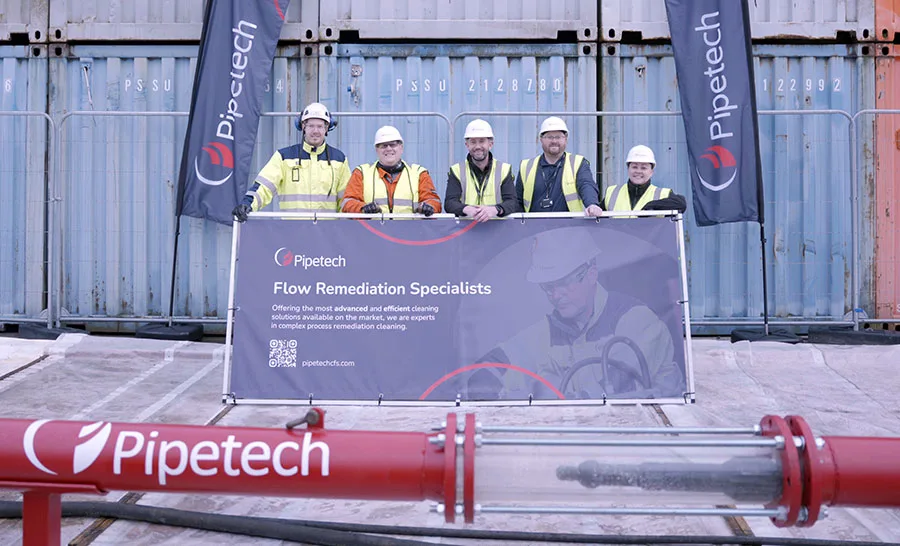
Supply-chain organisations have been navigating transitions of their own. For Pipetech, integration into the Denholm Environmental Group in Q2 2025 proved timely, enabling a year where combined expertise became essential to meeting client expectations. Throughout 2025, Pipetech delivered some of its most technically demanding cleaning and remediation campaigns to date – particularly across the Norwegian Continental Shelf (NCS) and within the UK refining sector. These projects highlighted shift in industry standards: high-precision execution, environmental responsibility and consistently repeatable performance have moved from being differentiators to baseline expectations.
Pipetech successfully executed a major UK campaign, delivering £2 million worth of inspection and cleaning services for a multinational operator. A 25 strong team was mobilised to clean several kilometres of complex pipework systems at a leading refinery. Using its Aqua Milling® technology, Pipetech removed oil-based debris responsible for severe blockages, restoring the system to a free-flowing state.
In parallel, the company delivered its strongest quarter in a decade on the NCS. Over the summer, Pipetech supported shutdown events across five offshore platforms for two clients – three with a major Norwegian operator and two with a US-based E&P company. More than 20 personnel and a suite of specialist technologies were deployed to clean produced-water systems and caissons, targeting scale and confirming results through camera inspections. The work contributed to more than 15 million NOK in Norwegian revenue for the quarter, alongside nearly £2 million of recently completed UK work.
However, the most significant step forward this year has been in technology development, particularly in flow remediation. As operators face increasing pressure to reduce chemical usage and lower environmental footprints, demand for mechanical, non-chemical alternatives has surged. In this context, Pipetech’s Downhole Scale Remediation (DSR) system made a groundbreaking leap, evolving from an R&D concept to a fully validated prototype.
The DSR extends Pipetech’s proven topside and subsea expertise into the downhole environment, supporting energy security, decarbonisation efforts and well-life extension across oil and gas, carbon capture and storage (CCS) and hydrogen applications. Following independent qualification in Aberdeen at the end of 2024, the DSR gained significant momentum in 2025 with operator-led testing and proof-of-concept trials. Patents granted across the UK, Europe and the US further secured its commercial position. Now at TRL 7, the system is preparing for multi-region field deployments in 2026.
Looking ahead, 2026 will be the year of real-world demonstration. Planned field trials across UK, Norwegian and international assets will test the DSR against complex well conditions, proving its ability to remove hard mineral scales, navigate challenging geometries and restore wellbore surfaces with minimal environmental impact. Successful execution will pave the way for full commercial launch at a time when demand for reliable, low-impact remediation technologies is at its peak.
The experiences of 2025 have made clear that innovation must be practical, environmental responsibility must be built in from the start, and value must be proven through transparent, measurable outcomes. With the sector moving from short-term fixes to long-term integrity solutions, Pipetech is well placed to contribute to that transition.