
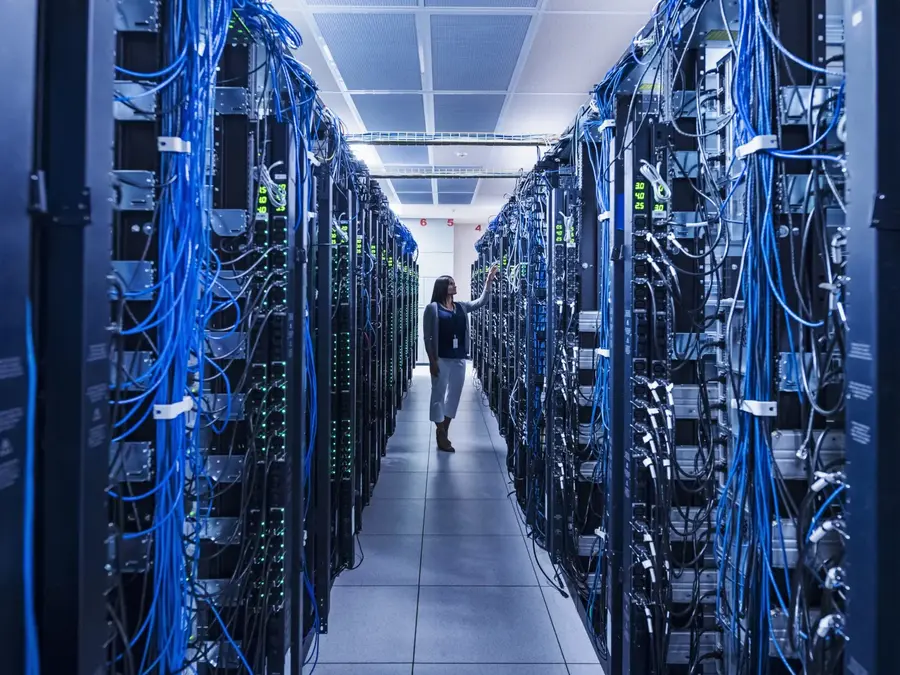
- The rapid deployment of high-performance computing and AI workloads is creating extreme thermal densities in data centers that conventional air-cooling systems can no longer efficiently manage.
- The data center cooling market is projected to reach $34.12 billion by 2033, driven by a technical shift towards liquid and hybrid architectures like direct-to-chip and immersion cooling.
- The cooling challenge is a major part of the energy transition, as cooling systems account for nearly 40% of a facility’s total energy usage, putting pressure on operators to improve efficiency and comply with stricter environmental regulations.
As hyperscale operators race to deploy increasingly powerful infrastructure, the thermal limits of traditional data centers are being tested, triggering a massive surge in demand for advanced cooling technologies.
According to a new report from Verified Market Reports, the global data center cooling market was valued at $14.21 billion in 2024 and is projected to reach $34.12 billion by 2033. This represents a compound annual growth rate (CAGR) of 10.3% over the forecast period, a trajectory driven by a fundamental shift in how the internet’s backbone is built and maintained.
This growth is not merely a capacity expansion; it is a technical evolution. The rapid adoption of high-performance computing (HPC) and AI workloads is forcing the industry to move beyond conventional air-cooling methods toward liquid and hybrid architectures capable of managing extreme thermal densities.
The Thermal Wall
For decades, data centers relied on raised floors and massive air conditioners to keep servers at operational temperatures. However, the latest generation of silicon, specifically the graphics processing units (GPUs) used for training large language models, generates heat far exceeding the capabilities of air-based systems.
Current rack densities in hyperscale facilities are pushing past 20 to 30 kilowatts (kW) per rack, with some AI clusters exceeding 100 kW. At these levels, air cooling becomes inefficient and economically unviable. The report identifies the “rapid expansion of hyperscale facilities” as a primary catalyst, accelerating the demand for direct-to-chip and immersion cooling technologies that can handle the thermal output of next-generation chips.
This technical necessity is creating a clear divide in the market. While legacy facilities struggle to retrofit, new builds are increasingly designed with liquid-first infrastructure.
Energy and Regulation
The cooling challenge is inextricably linked to the broader energy transition. Data centers are on track to consume more than 1,000 terawatt-hours (TWh) of electricity globally by 2026, according to the International Energy Agency (IEA), roughly equivalent to the total electricity consumption of Japan. And by 2030, S&P Global Energy says that data center energy use could hit 2,200 TWh, or the equivalent of India’s power consumption. Cooling systems typically account for nearly 40% of a facility’s total energy usage.

Consequently, efficiency metrics such as Power Usage Effectiveness (PUE) have moved from engineering goals to boardroom imperatives. The report notes that regulatory momentum in North America and Europe is influencing investment decisions, with governments imposing stricter standards on energy reporting and environmental performance.
“Growing emphasis on sustainability is reshaping vendor strategies,” the report states, highlighting a shift toward solutions that minimize water usage and integrate free-air economization. This is particularly critical in water-stressed regions where data centers face scrutiny for consuming millions of gallons of potable water annually for evaporative cooling.
Regional Power Shifts
North America remains the dominant force in the market, home to the world’s largest hyperscale operators and a robust ecosystem of connectivity providers.
However, the fastest growth is emerging elsewhere. The Asia-Pacific (APAC) region is witnessing accelerated adoption, driven by digitalization initiatives in Southeast Asia and government support for cloud infrastructure.
Meanwhile, Europe’s stringent environmental policies are forcing a faster transition to eco-friendly cooling designs, such as waste-heat recovery systems that channel excess data center heat into district heating networks.
The Capital Cost Barrier
Despite the clear operational benefits, the transition is not without hurdles. The report highlights high upfront capital expenditure (CAPEX) as a significant restraint, particularly for retrofitting legacy sites. Installing liquid cooling infrastructure requires specialized engineering and often significant structural modifications.
To mitigate these costs, vendors are introducing modular cooling units and scalable architectures that allow operators to upgrade capacity in phases. This “pay-as-you-grow” model is becoming essential for enterprises attempting to balance modernization with tight operational budgets.
A Liquid Future
As the industry looks toward 2033, the consensus is that the era of purely air-cooled data centers is drawing to a close for high-performance applications. The market is entering a “transformative phase,” according to the report, where cooling technology will serve as a competitive differentiator for operators.
With AI computational intensity expected to climb further, the ability to efficiently reject heat will determine which operators can support the workloads of tomorrow. For investors and industry observers, the cooling sector has transformed from a facility management afterthought into a critical pillar of the digital economy.
“When you share your news through OGV, you’re not just getting coverage – you’re getting endorsed by the energy sector’s most trusted voice.”